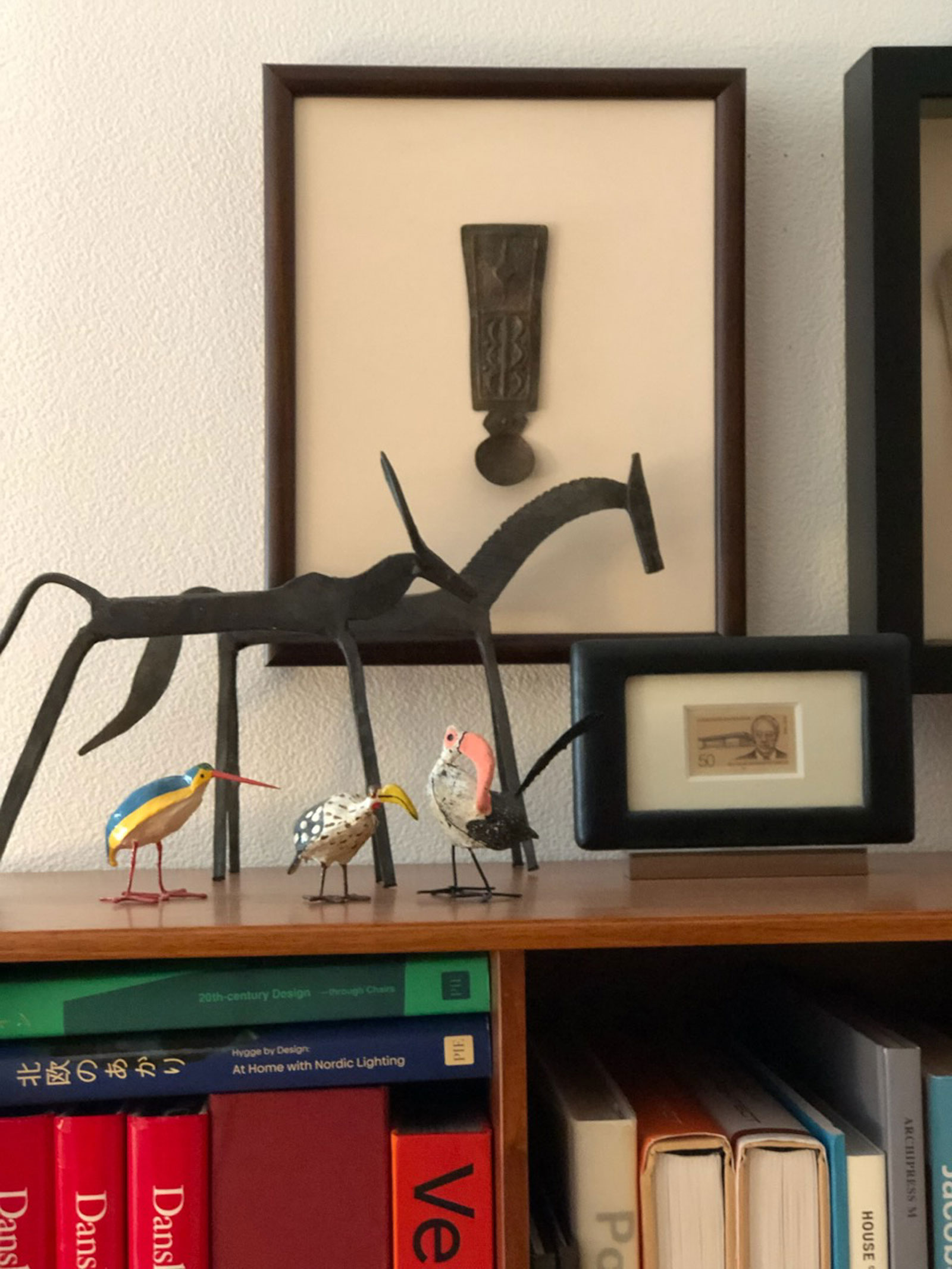
The spoon is displayed in the new home in Sapporo. In the foreground are African animal and bird objects. Each of the three birds was found in a different place. “You can see how well the features of each bird are captured.”
When I moved from Osaka to Asahikawa in 1994, what I found most lonely was how few chances there were to see beautiful design. At times, I even wondered if I could live there for long. During that period, the one place that truly supported me was a select shop called “Baihoudō,” located in Heiwadori Shopping Park in the center of Asahikawa. The owner had very good taste, offering fine items such as tableware and cutlery, as well as paintings and fashion. Some of these were things I had never seen even in Kansai. Because this shop existed, I may not have gone back to Osaka.
What does “a good object” mean? I have several ideas, but the main five are:
1 It is real, not an imitation. 2 It works well (including things that are useful even if they seem unnecessary). 3 It has a beautiful design that does not become boring. 4 Looking at it or using it makes the heart feel full and happy. 5 Owning it gives a sense of pride.
Because the Oda Collection is based on these ideas, it is very different from the art and craft items often seen in department stores.
The photograph shows a brass spoon made by the Akan people of West Africa, which I found at Baihoudō seven or eight years ago. From around the 15th to the 19th century, such spoons were made together with weights and scales and were used to measure gold dust during gold mining. Simple, bold carving has been added, giving the spoon a beautiful shape. Along with famous modern design works by well-known designers and makers from around the world, the Oda Collection also includes many objects like this—chosen according to my own values, without concern for price or rarity. Ritual masks made by minority ethnic groups are another good example. Using materials close at hand, they are shaped by hand into forms passed down through generations. The carved lines have no clear function, are not meant for mass production, and were not made to earn money. They are pure, natural beauty. They have much in common with Japanese mingei folk craft. Because time and care were put into them, these objects hold a warmth and pleasure that is hard to put into words.
In Africa, the Middle East, and India, many objects like these can be found, with simple yet beautiful forms. The same is true in Scandinavia. For example, the handles of puukko knives used by men who herd reindeer in Finland are made from reindeer antler or bone. Among the Sámi people, family-only patterns are sometimes carved into them. Inuit people have also made everyday tools from whale teeth and walrus tusks. Even in places a little distant from modern life, many beautiful objects exist.
I left my home in Higashikagura Town in eastern Hokkaido, where I lived for 23 years starting in 2002, and moved to Sapporo in the autumn of 2025. While preparing for the move, I removed the prints and original artworks from the living room wall. I was shocked at how plain the space suddenly felt—even though chairs by Kjærholm and Klint were still there. This experience once again showed me how important interior accessories are in improving the quality of a living space.